
Wondering how often does a pool need maintenance in Hawaii? Every week. That’s the short answer, and it’s not negotiable if you want to keep your water safe, your equipment running, and your pool free from algae.
But the “why” matters just as much as the “how often.” Hawaii’s climate creates pool conditions that don’t exist on the mainland, and understanding those conditions will help you make the right call about your pool care schedule. At Windward Pool and Spa, we service pools across Oahu, from Honolulu and Kailua to Kahala, Hawaii Kai, Lanikai, and Kaneohe, and we see the same story play out repeatedly: pools that skip consistent maintenance pay for it fast.
Here’s what you need to know.
How Often Does a Pool Need Maintenance in Hawaii and Why It’s Different From the Mainland
Most mainland pool guides suggest weekly or even bi-weekly service depending on the season. In Hawaii, that comparison doesn’t hold. Four environmental factors push pools on Oahu into a different category entirely.
The first is year-round warmth. Warm water is ideal for algae growth, and Hawaii never gives your pool a cold season to slow that biological pressure down. There is no winter break here. Algae conditions exist 365 days a year.
The second is UV radiation. Hawaii’s latitude puts it closer to the equator than any U.S. state on the mainland, which means UV exposure is significantly more intense. UV breaks down chlorine up to 30 percent faster than mainland averages. Without the right chemical stabilizer, you can add chlorine in the morning and have none left by the afternoon.
The third is tropical rainfall. Rain in Hawaii is slightly acidic, and a single heavy downpour can drop your pool’s free chlorine level by 50 percent or more. That shift happens fast. Rain also introduces organic debris, runoff, and phosphates into the water, all of which feed algae directly.
The fourth is salt air from trade winds. Coastal neighborhoods across Oahu, including Portlock, Diamond Head, and Aina Haina, deal with salt-laden air on a daily basis. That salt affects both water chemistry and equipment, accelerating corrosion of metal components at a rate two to three times faster than in mainland environments.
Together, these four factors create conditions where a pool that might hold its chemistry for ten days in Arizona can deteriorate in three days in Hawaii Kai.
How UV Radiation and Salt Air Change Your Pool Chemistry
UV and salt air deserve their own attention because they affect your pool in two distinct ways.
UV radiation is the primary reason chlorine management in Hawaii requires more precision. Chlorine without a UV stabilizer, specifically cyanuric acid (CYA), gets destroyed by sunlight within hours of direct exposure. CYA acts as a shield, slowing that breakdown and keeping your sanitizer active throughout the day. Without it at the correct level, your pool loses protection between service visits.
Salt air affects equipment differently. It attacks metal components: pump housings, filter hardware, ladder fittings, and electrical connections. In coastal areas of Oahu, equipment that a manufacturer rates for eight to twelve years of service life may need attention or replacement significantly sooner. That makes regular equipment inspection, not just chemical balancing, a non-negotiable part of your weekly service.
Pool Need Maintenance in Hawaii: The Recommended Schedule
The answer to “how often does a pool need maintenance in Hawaii?” can change. However, for residential pools on Oahu, the answer is consistent across pool types, pool sizes, and neighborhoods: once per week, every week, without gaps.
Bi-weekly service, which works in cooler or drier mainland climates, is not a reliable approach here. Water chemistry can shift meaningfully within three to four days of a service visit. Algae can begin to establish on shaded walls and steps within one week of a missed treatment. By the time a bi-weekly visit rolls around, a pool that looked fine at the last service may already have problems that require corrective treatment.
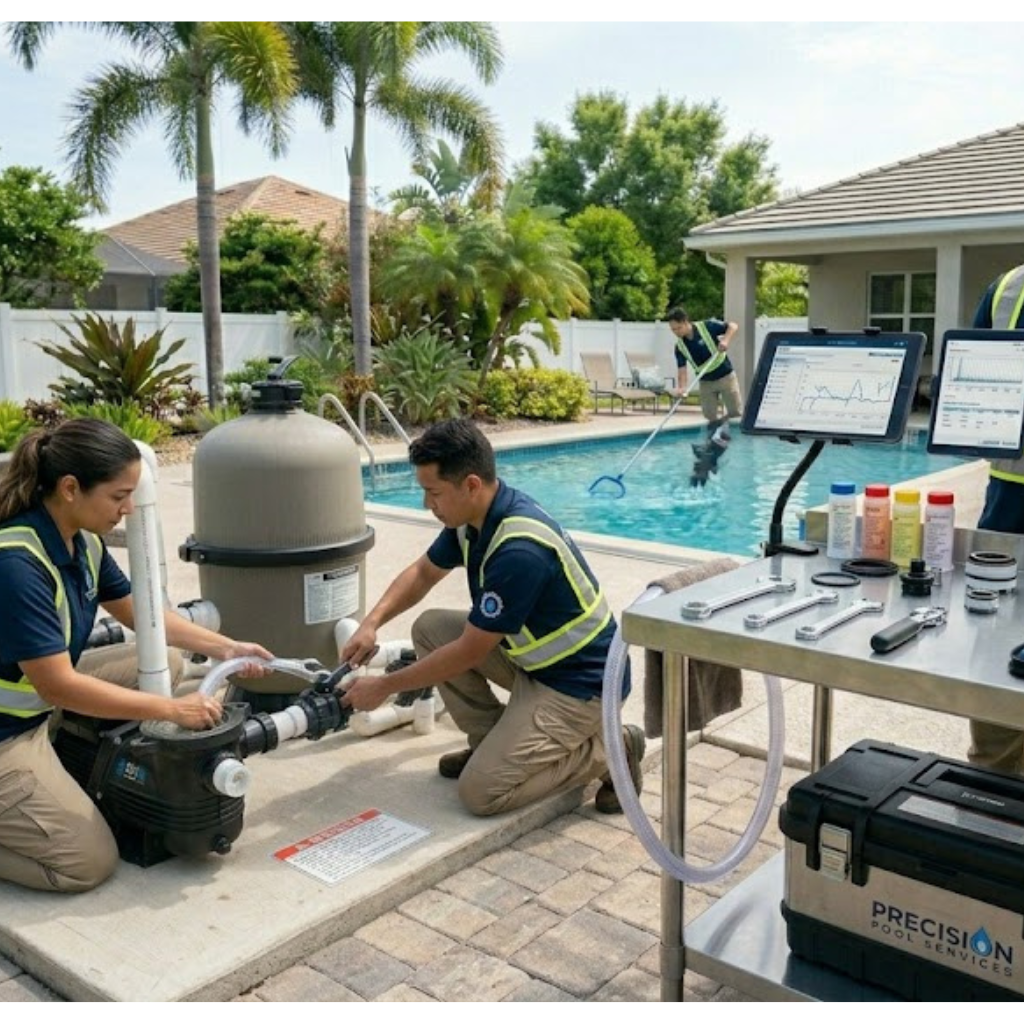
A complete weekly pool maintenance visit covers skimming debris from the surface, brushing walls, steps, and tile, vacuuming the pool floor, emptying pump and skimmer baskets, testing water chemistry, chemical balancing, and a basic equipment inspection. Each of those tasks protects a different part of your pool system, and skipping any of them creates a gap that Hawaii’s environment will exploit quickly.
How Hawaii’s Wet Season and Dry Season Affect Your Pool Maintenance Schedule
Hawaii does have seasonal patterns, even if they’re less dramatic than mainland seasons. Oahu’s wet season runs roughly from October through March. The dry season runs from April through September. Both affect your pool, but in different ways.
During the wet season, rain is your biggest challenge. Frequent downpours dilute chlorine, push pH toward acidic levels, and flood the pool with organic debris and runoff. If you’re in a neighborhood with significant rainfall like Manoa or Kaneohe, you may need additional chemical adjustments between your weekly visits. Testing water within 24 hours of a heavy storm is the responsible approach.
During the dry season, the pressure shifts. Higher evaporation means water levels drop faster. More intense UV exposure increases chlorine consumption. And heavier pool usage from more swimmers adds contaminants like sunscreen, body oils, and sweat that consume sanitizer and create surface buildup at the waterline.
Neither season is forgiving. Both require consistent weekly attention.
What to Do After Heavy Rain or a Storm on Oahu
Heavy rain is one of the most common triggers for pool problems on Oahu, and it can happen any time of year.
After a significant rainfall, test your water as soon as possible. If free chlorine has dropped below a safe level, shock treatment may be needed to restore sanitizer and kill any bacteria or early algae that entered with the runoff. Organic debris that lands in the pool after a storm breaks down into phosphates, the primary food source for algae, so removing it quickly matters.
At Windward Pool and Spa, we account for storm events as part of our weekly pool service across Honolulu, Hawaii Kai, Kailua, Kahala, and the rest of Oahu. If your pool sits in a low-lying yard or collects runoff from surrounding landscaping, that’s a factor we note and address during every visit.
How Often Do Specific Pool Maintenance Tasks Need to Be Done in Hawaii?
Different tasks have different timelines, and knowing them helps you understand what a quality weekly service actually covers.
Surface skimming and basket emptying should happen every visit. During heavy debris periods, such as when plumeria flowers are dropping or after a windy stretch, more frequent attention between scheduled visits helps prevent clogged filters.
Wall and floor brushing needs to happen at every weekly visit without exception. Brushing disrupts early algae before it can establish on pool surfaces. In Hawaii’s warm, humid conditions, algae does not need much time to take hold on unbrushed surfaces.
Water chemistry testing should happen at minimum twice per week. Your weekly service provider handles one of those rounds. If your pool sees heavy usage, test mid-week as well.
Chemical balancing happens at every weekly visit, adjusted based on actual test results rather than a fixed formula.
Filter cleaning or backwashing needs to happen every one to two weeks in Hawaii’s debris-heavy environment. A clogged filter cannot remove the microscopic particles that feed algae, and skipping filter maintenance is one of the fastest ways to lose water clarity.
Equipment inspection happens at every weekly visit. Catching a worn impeller, a cracked skimmer basket, or a leaking fitting early costs far less than discovering it after damage compounds.
A professional water analysis at least once per year is a solid baseline. In areas like Kailua and Kahala, where environmental conditions vary and water turnover differs, more frequent analysis may be warranted based on your pool’s specific setup.
What Happens When You Skip Pool Maintenance in Hawaii?
When we say that the answer to “how often does a pool need maintenance in Hawaii?” is “one week” we mean it. Missing one week of pool service in Hawaii is not the same as missing one week on the mainland.
Within three to four days of a missed chemical treatment, chlorine levels can drop to the point where algae protection is compromised. Then, within a week, you may see the early signs: a slight green tint to the water, slippery walls, or cloudy patches near steps and corners. Within two weeks of neglect, a pool on Oahu can go from swim-ready to a full algae bloom that requires shock treatment, extended vacuuming, and multiple days of recovery before it’s safe to use again.
That recovery costs more in chemicals, time, and professional labor than a consistent weekly maintenance schedule would have. And algae is not the only risk. Unbalanced water chemistry, even when the pool looks relatively clear, can irritate swimmers’ eyes and skin, degrade pool surfaces over time, and shorten equipment lifespan significantly.
There is no off-season on Oahu. The algae pressure, the UV exposure, the salt air, and the rain do not pause. Your Hawaii pool maintenance schedule cannot pause either.
Why Professional Weekly Pool Service on Oahu Is Worth It
Pool maintenance in Hawaii demands precision. Getting water chemistry right in an environment where UV, rain, and salt air all work against your chemical balance simultaneously requires experience and proper testing equipment.
Professional weekly service from Windward Pool and Spa replaces personal time spent for upkeep commitment with consistent, expert care. We service residential and commercial pools across Honolulu, Kailua, Kaneohe, Kahala, Aina Haina, Hawaii Kai, Lanikai, and throughout Oahu. Our team handles everything from routine cleaning and chemical balancing to equipment inspection and pool repairs, all built around what Oahu’s environment actually demands from your pool.